From blog writers to ad specialists—how to scale with contractors to build your content team.
Let’s be real: the content treadmill never stops.
There’s the blog you meant to publish three weeks ago.
The email sequence that still isn’t written.
The landing page that almost converts… but not quite.
You know content marketing works, but finding the time, team, and talent to make it consistent? That’s where most businesses get stuck.
So let’s talk about how to fix that.
This is your no-fluff guide to building a plug-and-play content team without committing to full-time salaries, onboarding rituals, or another round of hiring roulette.
Whether you’re a startup founder, lean marketing team, or brand leader ready to grow, here’s how to build a flexible, strategic content operation with contractors who know what they’re doing.
Why You Don’t Need a Full-Time Content Team (Yet)
If you’re still debating whether you need to hire in-house, here’s some tough love: you probably don’t.
Unless you’re a content-led enterprise or publishing at a daily cadence, the overhead of a full-time content team (writers, designers, editors, SEO pros, email marketers, ad copywriters, social strategists…) can outweigh the output.
Here’s why the plug-and-play model wins:
- Speed to scale: Hire what you need, when you need it
- Cost control: No benefits, no payroll taxes, no long-term commitment
- Specialized skill sets: Get pros for each channel—not one generalist doing everything “meh”
- Flexibility: Ramp up or down as your campaigns shift
Your lean, contract-based content team is your secret weapon. The key is building it right.
Step 1: Know What Content Team Roles You Actually Need
Before you go looking for talent, get clear on what your real needs are.
Ask:
- What content are we already producing—and what’s missing?
- Where are we seeing the most ROI? (Blog? Email? Paid ads?)
- What’s bottlenecking our growth?
Then match your needs to these core roles:
Core Plug-and-Play Content Roles
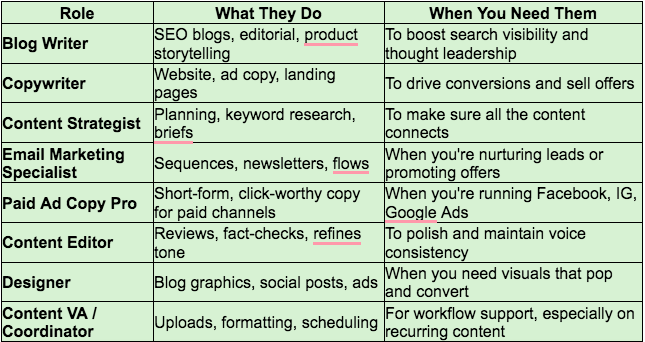
Start small. Prioritize the one or two roles that would remove the biggest bottleneck right now.
Step 2: Source Contractors Who Think Like a Content Team
Here’s where most brands go wrong:
They hire a bunch of freelancers in isolation, toss them assignments, and hope it all magically fits together.
Spoiler: it won’t.
The key to building a plug-and-play content team is hiring people who don’t just deliver tasks—they think strategically and collaborate easily.
Red flags to avoid:
- “Just give me the topic and I’ll write it” (without asking about audience, goals, etc.)
- No examples of cross-functional work (like partnering with a designer or strategist)
- “I can do it all!” (generalists who aren’t great at anything)
Green flags to look for:
- They ask about your funnel, your brand voice, your goals
- They suggest content ideas, not just execute yours
- They work well with your existing team (or other contractors)
You want contractors who think like owners, not just order-takers.
Step 3: Create Simple Systems (That Don’t Suck Your Time)
Hiring contractors doesn’t mean giving up control. But if you don’t create simple systems, you’ll end up micro-managing or redoing everything.
Here’s what you need to keep things moving:
1. A shared content calendar
Use Notion, Asana, Trello, ClickUp—whatever works for your brain.
Include:
- Deadlines
- Assigned team member
- Status
- Links to briefs/assets
2. A living style guide
Your tone, voice, formatting rules, links to past content that feels “right.”
This helps every contractor align with your brand faster.
3. Shared folders + file structure
Google Drive or Dropbox. Organized by type (blog, social, email), not chaos.
4. A kickoff process for new content
Quick briefs > long SOPs.
Include:
- Audience
- Goal of the content
- CTA
- Keywords
- Examples you like (or hate)
Set it once, and your team runs with it.
Step 4: Pay Smart, Not Cheap
You can find a $50 blog writer on Upwork. You can hire someone to write your Facebook ads for $25.
But you’ll end up rewriting it—or worse, publishing it and wondering why it’s not working.
Here’s a rough pricing guide that balances skill and value:
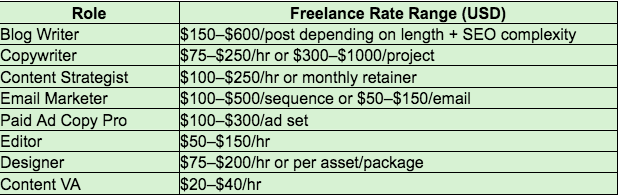
Note: Contractors who offer strategy + execution? Worth every penny.
Step 5: Keep It Flexible, But Build Loyalty with Your Content Team
The beauty of a plug-and-play content team is agility. But the risk? Constant churn and retraining.
So while you don’t need to lock anyone into full-time contracts, do invest in building long-term relationships with your top contractors.
Tips:
- Give consistent feedback
- Pay invoices quickly
- Share results (they love knowing a landing page they wrote converted at 28%)
- Invite them into planning convos or brainstorms
The more ownership they feel, the better your content will perform.
Bonus: What a Plug-and-Play Content Team Looks Like in Action
Scenario: You’re launching a new product next month.
Your plug-and-play team could include:
- Content Strategist to map the campaign and assign tasks
- Copywriter to write the landing page and paid ads
- Blog Writer to publish 2 SEO pieces around related pain points
- Email Marketer to build a 5-part launch sequence
- Designer to create visuals for the blog, ads, and social
- VA to schedule posts and upload blogs
All done in 2–3 weeks, without hiring a single full-time employee. That’s the magic.
Think Like an Editor, Not a Boss
The biggest mindset shift when building a contract content team?
You’re not “managing employees”—you’re curating talent and editing outcomes.
Your job becomes:
- Knowing the goal of your content
- Hiring the right person for each piece
- Setting expectations clearly
- Giving feedback that makes future work even better
The more you treat your freelancers like trusted partners (not production robots), the better your content (and your results) will be.

Need a plug-and-play content pro to kickstart your marketing?
Whether you need a blog writer, email copy specialist, or someone to help wrangle it all into a plan that actually gets done—Just Let Dez Write It.
Scalable, strategic, and built to fit.
No new-hire hassles required.